

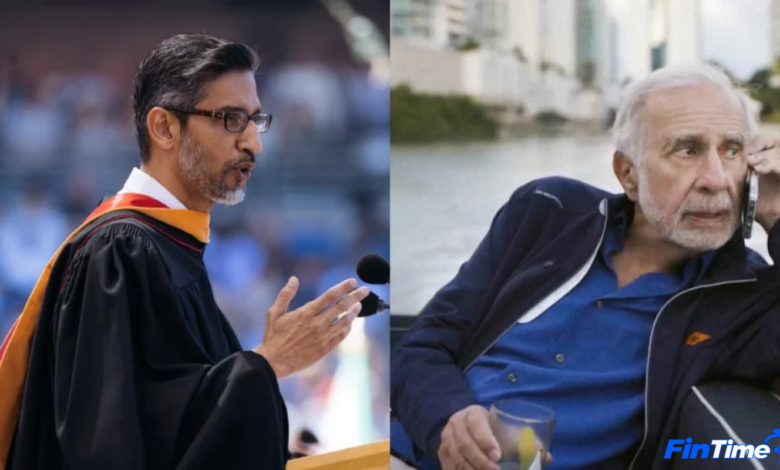
When two influential figures from different corners of the business world appear together in online searches, curiosity naturally follows. What connects a technology executive who leads Google and Alphabet with a veteran investor known for challenging corporate boards and influencing major business decisions? The growing interest in Sundar Pichai and Carl Icahn raises an important question: is there a direct relationship between the two, or are their names connected through the broader history of technology, corporate acquisitions, and shareholder activism?
The answer requires a closer look at their careers, Google’s corporate history, Carl Icahn’s investment strategy, and the difference between documented business connections and online speculation. Although both men have influenced major corporate decisions in the United States, their professional roles are substantially different. Their names appearing together does not, by itself, establish a personal relationship, partnership, or shared investment.
Who Are Sundar Pichai and Carl Icahn?
Sundar Pichai and Carl Icahn are prominent business figures, but they operate in different professional environments. One is associated with technology development and corporate management; the other is known for investing in companies and pressing management teams to consider changes that may increase shareholder value.
Understanding these differences is the first step toward understanding why people may compare them.
Who Is Sundar Pichai?
Sundar Pichai is the chief executive officer of Google and its parent company, Alphabet Inc. Born in Chennai, India, he studied engineering at the Indian Institute of Technology Kharagpur before earning a master’s degree at Stanford University and an MBA from the Wharton School.
Pichai joined Google in 2004. During his early years, he helped develop and manage products including Google Toolbar and Google Chrome. He subsequently took on broader responsibilities across Google’s product and engineering operations.
He became Google’s CEO in 2015 and assumed the role of Alphabet CEO in December 2019.
His responsibilities encompass several major areas:
- Artificial intelligence: Guiding Google’s AI development and the integration of AI into its products.
- Search and advertising: Overseeing businesses central to Google’s commercial model.
- Cloud computing: Supporting Google Cloud’s growth and enterprise technology offerings.
- Corporate strategy: Allocating resources, managing operations, and setting long-term priorities.
- Shareholder value: Balancing investment in innovation with financial performance and investor expectations.
Pichai’s leadership is particularly relevant as technology companies compete in generative AI, cloud services, digital advertising, and emerging computing technologies.
Read More: Toussaint L. Jones: His Marriage to S. Epatha Merkerson and Life Today
Who Is Carl Icahn?
Carl Icahn is an American investor widely associated with shareholder activism. He built his reputation by acquiring significant stakes in companies and advocating changes to their strategies, governance, capital allocation, or management.
He established Icahn & Co. in 1968 and subsequently became known for taking influential positions in publicly traded businesses.
Icahn’s investment history includes companies in technology, telecommunications, energy, automotive manufacturing, and consumer products. His investment vehicle, Icahn Enterprises, operates across several business sectors.
His approach differs from that of a conventional passive investor. Rather than simply purchasing shares and waiting for a company to grow, an activist investor may seek to influence corporate decisions through shareholder engagement, public campaigns, board representation, or formal proposals.
Icahn’s activities have made him a prominent figure in discussions about corporate governance and the responsibilities of public-company management.
Why Are Sundar Pichai and Carl Icahn Appearing Together?
The key question is whether the two men have a documented direct connection.
The important distinction is that shared business context does not prove a personal or professional relationship. Available corporate biographies establish Pichai’s leadership at Google and Alphabet and Icahn’s history as an activist investor. However, those facts alone do not establish that they have worked together, met privately, or entered into a business agreement.
One relevant area of historical context is the relationship between major technology companies and activist investors during corporate transactions. Google’s acquisition of Motorola Mobility is an example of a transaction that helps explain why corporate strategy, investor influence, and technology leadership are sometimes discussed together.
It is important, however, not to attribute the transaction directly to Pichai or to imply that Icahn’s involvement in Motorola established a direct relationship between the two men.
Several factors may explain the search interest:
- Technology-sector history: Both names are associated with influential decisions involving major corporations.
- Corporate acquisitions: Google’s Motorola transaction attracted attention from investors, technology observers, and financial journalists.
- Investor activism: Icahn’s history of challenging corporate management makes his activities relevant to discussions about company strategy.
- Online search behavior: Search engines and content platforms can place names together because users are researching overlapping topics, not necessarily because a new relationship exists.
The most responsible interpretation is to investigate the specific claim behind a search result rather than assume that two names appearing together indicate a confirmed partnership.
The Motorola Mobility Connection: Why Corporate History Matters
One historical topic worth understanding is Google’s acquisition of Motorola Mobility in 2011. The transaction illustrates how technology strategy, shareholder interests, and major corporate decisions can overlap, even when the individuals involved do not necessarily share a direct working relationship.
Why Did Google Acquire Motorola Mobility?
In August 2011, Google announced an agreement to acquire Motorola Mobility for approximately $12.5 billion. The transaction was completed in May 2012.
The acquisition was significant because Motorola Mobility owned a substantial portfolio of mobile technology patents. Google faced increasing competition in the smartphone market, where Android competed with Apple’s iOS and other mobile platforms.
The acquisition offered Google several potential advantages:
- Patent protection: Motorola’s intellectual property could help Google and Android partners respond to patent disputes.
- Mobile technology expertise: Motorola brought experience in designing and manufacturing mobile devices.
- Strategic flexibility: The deal gave Google greater control over certain hardware and intellectual property assets.
- Android ecosystem support: Strengthening Google’s position in mobile technology could help protect the broader Android platform.
The transaction also demonstrated the complexity of buying a technology business. An acquisition price reflects more than the immediate value of products sold; it can also include patents, strategic opportunities, competitive advantages, and assets that may be difficult to value independently.
Where Does Carl Icahn Fit Into This History?
Carl Icahn was involved with Motorola before Google’s acquisition. His investment activity and public commentary about the company’s strategic position form part of the wider corporate history surrounding Motorola.
However, the chronology matters. Google’s agreement to acquire Motorola Mobility was announced in 2011, when Larry Page was Google’s CEO. Pichai was then a senior Google executive whose career was focused on products and technology, including Chrome.
Consequently, it would be misleading to describe the Motorola transaction as a business deal between Sundar Pichai and Carl Icahn without specific documentary evidence supporting that claim.
The distinction is particularly important for search-focused articles. A historical relationship between an investor and a company is not automatically a relationship between that investor and every executive who later leads the company.
What Happened After the Acquisition?
In January 2014, Google announced an agreement to sell Motorola Mobility’s handset business to Lenovo for approximately $2.91 billion. The deal was completed later that year.
At first glance, comparing the original acquisition price with the later sale price might suggest that Google simply lost the difference. That interpretation is incomplete.
Google retained the vast majority of Motorola’s patent portfolio, which had been one of the strategic motivations behind the acquisition. The original transaction and the later sale therefore involved different packages of assets.
The lesson: Corporate transactions must be evaluated by examining what was purchased, what was sold, which assets were retained, and what strategic benefits the company gained. A simple comparison of two headline prices cannot tell the entire story.
This history provides useful context for readers researching Sundar Pichai and Carl Icahn, but it does not establish that the two men personally negotiated or jointly participated in the Motorola acquisition.
How Do Their Business Philosophies Differ?
Although both figures operate within the corporate world, their responsibilities and incentives are different.
| Business factor | Sundar Pichai | Carl Icahn |
|---|---|---|
| Primary role | Technology executive | Investor and shareholder activist |
| Main focus | Products, innovation, and corporate operations | Investment returns and corporate changes |
| Typical influence | Executive decisions and business strategy | Shareholder pressure and investment positions |
| Main areas of interest | AI, search, cloud computing, digital advertising | Valuation, governance, capital allocation, and restructuring |
| Time horizon | Long-term business development alongside near-term performance | Investment-dependent, often focused on identifiable opportunities for value creation |
Pichai’s Management Approach
As a chief executive, Pichai must make decisions involving competing priorities. Investing in AI infrastructure, for example, may require substantial spending before the resulting products generate enough revenue to justify that investment.
He must also consider customer experience, competition, regulatory obligations, employee priorities, and shareholder expectations.
A technology company cannot necessarily optimize every business decision for immediate financial returns. Some investments are designed to create capabilities that may become commercially valuable over several years.
Icahn’s Activist Investing Approach
Activist investors often look for businesses they believe are undervalued, poorly managed, or using capital inefficiently. They may advocate changes such as selling noncore assets, repurchasing shares, reducing costs, changing board membership, or reviewing a company’s strategic direction.
These proposals can produce disagreements with management.
Supporters argue that activism can make companies more accountable and improve capital allocation. Critics point out that certain activist campaigns may prioritize short-term returns over long-term investment, employees, or other stakeholders.
Neither approach automatically guarantees success. Outcomes depend on the company’s circumstances, the proposed changes, the market environment, and the quality of execution.
How to Research Sundar Pichai and Carl Icahn Accurately
If you are searching for a connection between these two business figures, a structured research process can help you separate established facts from assumptions.
Step 1: Identify the Original Claim
Begin by asking what the article, video, or social media post actually claims.
Does it say the two men met? Does it allege that Icahn invested in Alphabet? Does it discuss Motorola’s acquisition? Or does it simply mention both names in a headline?
These are different claims requiring different evidence.
Step 2: Check Corporate Filings
Public-company disclosures are particularly useful for investigating ownership, executive responsibilities, and significant corporate transactions.
Alphabet’s 2026 proxy statement identifies Pichai as the company’s CEO and director and reports ownership information for executives and other significant shareholders. Corporate filings can help establish whether a publicly reportable investment or formal corporate relationship is documented. SEC+1
For investment research, pay attention to these documents:
- Schedule 13D: Generally used by beneficial owners reporting more than 5% of a covered class of equity securities when the applicable conditions require it.
- Schedule 13G: An alternative disclosure for certain qualifying beneficial owners.
- Form 13F: Reports specified securities holdings of qualifying institutional investment managers, subject to reporting requirements and limitations.
- Proxy statements: Explain board composition, executive responsibilities, shareholder voting, and certain ownership information.
No single filing provides a complete picture of every possible financial relationship. For example, a Form 13F is not a real-time record of all investments and does not disclose every type of financial exposure.
Step 3: Establish a Timeline
A timeline prevents events from different years from being incorrectly combined.
| Year | Relevant event |
|---|---|
| 2004 | Sundar Pichai joined Google. |
| 2011 | Google announced its agreement to acquire Motorola Mobility. |
| 2012 | Google completed the Motorola Mobility acquisition. |
| 2014 | Google announced the sale of Motorola Mobility’s handset business to Lenovo. |
| 2015 | Pichai became Google’s CEO. |
| 2019 | Pichai became Alphabet’s CEO. |
This chronology shows why the Motorola story requires careful wording: the acquisition agreement preceded Pichai’s appointment as Google CEO.
Step 4: Separate Evidence From Interpretation
A useful research article should clearly distinguish three categories:
- Documented facts: Information supported by corporate disclosures, official biographies, and transaction announcements.
- Reasonable analysis: Explanations of why an event matters to investors or the technology industry.
- Unverified claims: Allegations of private meetings, undisclosed partnerships, or motives that lack reliable evidence.
Keeping these categories separate improves accuracy and helps readers make informed judgments.
What Can Business Owners Learn From Their Careers?
The careers of Pichai and Icahn offer several practical lessons for entrepreneurs, investors, and professionals.
Build Long-Term Value
Pichai’s career illustrates how product expertise and progressively greater responsibilities can lead to executive leadership. Businesses can apply the same principle by investing in capabilities that produce lasting customer value rather than focusing exclusively on short-term attention.
Question Assumptions
Icahn’s activist-investing approach demonstrates the importance of examining how companies use their resources. Business owners can apply this idea by reviewing unnecessary expenses, evaluating underperforming products, and regularly measuring the results of strategic decisions.
Evaluate Decisions Using Evidence
Neither a charismatic executive nor a famous investor should be treated as automatically correct.
Before adopting a business strategy, ask:
- What problem is the proposed change intended to solve?
- What evidence supports the proposed solution?
- What are the likely costs and risks?
- How will success be measured?
- What unintended consequences might follow?
These questions are useful whether you are evaluating a technology acquisition, a new business investment, or a company’s long-term strategy.
Conclusion
Sundar Pichai and Carl Icahn represent two influential but distinct sides of the American business landscape. Pichai is known for leading Google and Alphabet through major changes in technology, digital services, and artificial intelligence. Icahn is known for activist investing and his efforts to influence corporate strategy and shareholder value.
Their names appearing together can prompt legitimate questions about technology acquisitions, investor influence, and corporate governance. Google’s historical acquisition of Motorola Mobility provides relevant context because Motorola had its own investor history, including Icahn’s involvement before the acquisition.
However, that context should not be confused with proof of a direct relationship between Pichai and Icahn. The available evidence discussed in this article does not establish that they entered into a partnership, personally negotiated the Motorola transaction, or jointly pursued a business strategy.
For readers researching sundar pichai and carl icahn, the most useful next step is to identify the specific claim that prompted their interest and verify it against reliable corporate records. Understanding the difference between a documented event and an assumed connection is essential for accurate business reporting and responsible investment research.
Ultimately, the story is not simply about two famous names. It is about how technology leadership, investor activism, and corporate history intersect—and why reliable evidence matters when interpreting that intersection.
FAQs
1. Who are Sundar Pichai and Carl Icahn?
Sundar Pichai is the CEO of Google and Alphabet, responsible for leading their businesses and technology strategy. Carl Icahn is a prominent American investor known for shareholder activism and efforts to influence the companies in which he invests.
2. Are Sundar Pichai and Carl Icahn business partners?
There is no reliable evidence established here that they are business partners. Their careers intersect in the broader context of corporate strategy and technology-sector history, but that does not prove a direct business relationship.
3. Why are Sundar Pichai and Carl Icahn associated with Motorola?
Icahn had investment interests involving Motorola before Google’s acquisition of Motorola Mobility in 2011. Google pursued the acquisition for strategic reasons that included Motorola’s patent portfolio. The historical overlap does not establish that Pichai and Icahn personally worked together on the deal.
4. Did Carl Icahn invest in Alphabet or Google?
The historical context discussed here does not establish a significant activist investment by Icahn in Alphabet. A definitive assessment of his holdings at any particular date requires examining the relevant public filings, while recognizing that those filings have reporting limitations.

One Comment